Experimental Studies of Planetary Materials
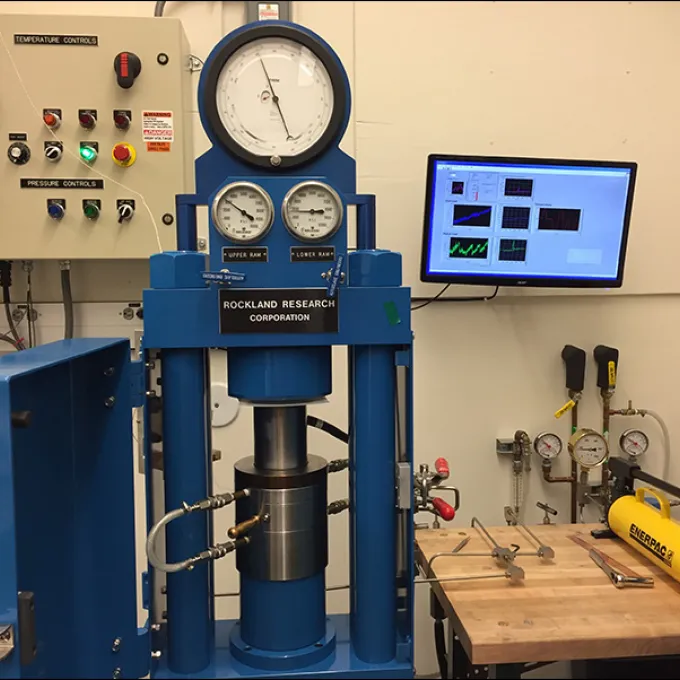
The ESPM group uses experimental approaches to study the mechanical and chemical behavior of rocks and minerals. The group is comprised of two labs: the rock deformation lab and the experimental geochemistry lab.
The Rock Deformation Lab (PI: Phil Skemer) studies mantle deformation, the formation and the dynamics of plate boundaries, and the interpretation of seismological data. The underlying motivation is to understand the remarkable phenomenon of plate tectonics and its variability among the terrestrial planets. The lab's research strategy is to use geologic or seismological observations to design experiments. They study the microstructures of naturally deformed rocks to infer the importance of specific deformation processes, and then develop experiments to investigate the sensitivity of these processes to a range of deformation conditions. From these experiments, we can make predictions about rock deformation at conditions or locations that are inaccessible to direct observation.
The Experimental Geochemistry Lab (PI: Mike Krawczynski) simulates planetary interior pressure and temperature conditions, and uses new ultra-precise analysis methods to measure element fractionation, phase equilibria, and isotopic partitioning and diffusion. The general goal of our research is to constrain the chemical fingerprints and time scales of melting and crystallization processes in the terrestrial planets and asteroids, and to determine rates and magnitudes of a variety of aspects of silicate and metal behavior that have previously proved difficult to determine. Combining a laboratory-based approach with thermodynamic, geochemical modeling, and petrographic studies, our lab is advancing the understanding of igneous processes in the solar system.
The ESPM group has a wide range of analytical facilities at its disposal. These facilities are supported by the group, the Department of Earth and Planetary Sciences, or the Institute for Materials Science Engineering.