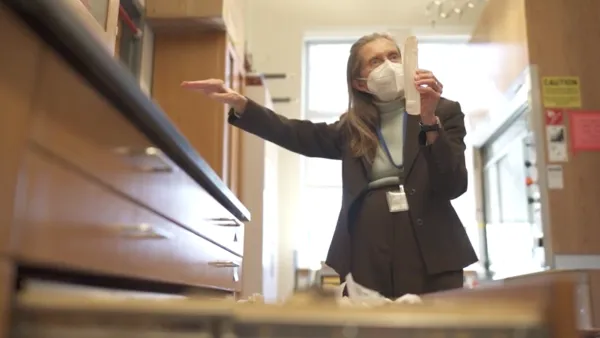
Professor Pasteris retired at the end of December, 2020, after 41 years on the faculty at Washington University. Much of her research during that time demonstrated a traditional mineralogic-geologic approach to non-traditional materials, especially after her involvement in Raman microprobe spectroscopy.
The latter encouraged multi-disciplinary collaborations with many knowledgeable colleagues, and work in one subfield for several (or more) years often led into yet another direction, e.g.: mineralogy and geochemistry of ore deposits; mineralogy and associated fluids in the mantle; development of Raman microprobe analysis of minerals and fluid inclusions; interplay of composition, mineral structure, and physical-chemical properties in the apatite mineral group (focused on bone and synthetic apatites); environmental mineralogy, particularly the importance of lead-bearing minerals (especially those of variable composition) in the contamination and decontamination of drinking water flowing through lead pipes; and applications of Raman spectroscopy in most of the above studies plus development of Raman spectrometers and spectroscopy on the seafloor. Her final collaboration was with colleagues from the School of Engineering, one of whose goals was the growth and long-term stabilization of lead-bearing minerals that form protective mineral scales on the inner walls of lead pipes. The aim is to eliminate the cause of lead poisoning due to the historical use of lead service pipes to bring drinking water into homes in the US and elsewhere.
More details can be found in the papers published by Professor Pasteris and her colleagues and students, listed at the site indicated below.