High-Temperature Isotope Geochemistry
The Parai laboratory, overseen by Professor Rita Parai, pursues high-precision measurements of isotopes in rocks to better understand the formation and evolution of planetary bodies. Specifically, she and her students pursue topics related to the early Earth, lunar formation, the origin and evolution of Earth’s volatile budgets, chemical cycling between deep Earth and surface reservoirs, the nature of mantle heterogeneities and chemical constraints on geodynamics.
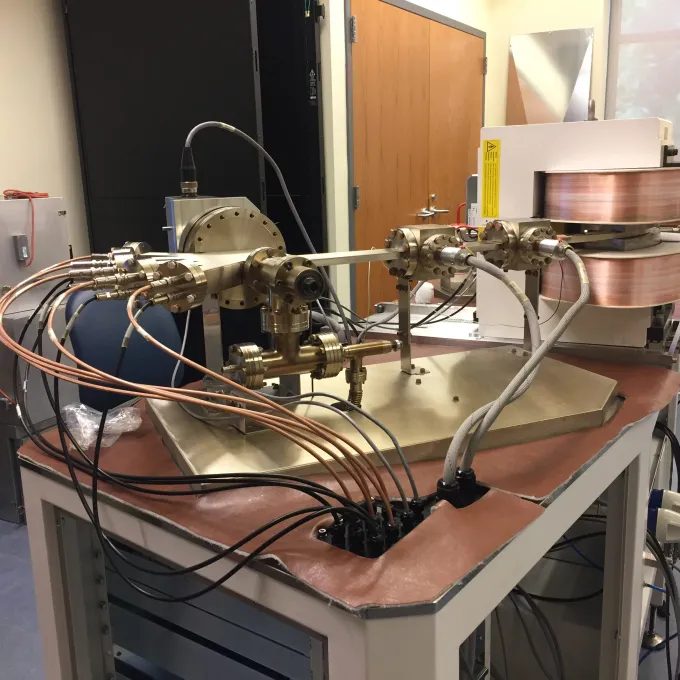
The lab's main analytical facility is the Noble Gas Laboratory. Noble gases are unique geochemical tracers, in that they do not participate in reaction chemistry. Rather, noble gas isotopic compositions are primarily affected by radioactive decay of assorted parent isotopes on a variety of timescales. High-temperature isotope geochemistry studies have long focused on radiogenic isotope systems, such as U-Pb, Rb-Sr, Sm-Nd and Hf-W. We expand the radiogenic isotope toolbox to include constraints from noble gas isotope systematics. Using state-of-the-art multicollector mass spectrometry, high-precision measurements may shed new light on topics such as the state of the early Earth, and chemical exchange between deep Earth and surface reservoirs.