
Earth's unique form of plate tectonics, where the surface is divided into moving plates with active boundaries and stable interiors, has not been conclusively found on other rocky planets in our solar system. Could this process be happening on distant planets too?
Philip Skemer, a professor of Earth, Environmental, and Planetary Sciences and a fellow of the McDonnell Center for the Space Sciences, both at Washington University in St. Louis, led the research which delved into this question. He and his research team studied how the composition of exoplanets, that is, planets outside our solar system, might influence their ability to develop plate tectonics. By using data from stars, they predicted the makeup of Earth-sized exoplanets and modeled how these compositions could affect the formation of plate boundaries.
"Since the scientific revolution brought on by the discovery of plate tectonics, we’ve learned a tremendous amount about how plate boundaries work. It’s interesting, now, to start thinking about how plate boundaries might operate on other worlds that are both similar and dissimilar to our own," said Skemer.
Their research yielded intriguing results. Planets whose mantles are made of roughly equal parts of two minerals are more likely to rapidly form the shear zones needed for plate tectonics. Meanwhile, planets with a mantle dominated by one mineral might struggle to develop such geological activity.
Although Earth is the only known planet with active plate tectonics, there could be many exoplanets out there with the right conditions. Detecting Earth-sized exoplanets is challenging due to technological limitations, but advancements are improving our capacity to study these smaller bodies. Recent findings suggest some of these exoplanets have surfaces composed of basalt, a rock that is created partially melting a mantle with the same composition as Earth’s.
The team's findings, recently published in JGR Planets, suggest that many exoplanets have the potential to develop plate tectonics, especially those with a mix of different minerals in their mantles. About 29% of the exoplanets modeled for this study had no dominant mineral, making them likely candidates for forming shear zones more quickly. Thus, the hunt for Earth-like planets should focus on stars with planets that have these balanced mineral compositions.
This research highlights the vital role planetary composition plays in tectonic activity and brings us closer to discovering geologically active worlds beyond our solar system.
This work was supported by a grant from NSF: EAR-2348666.
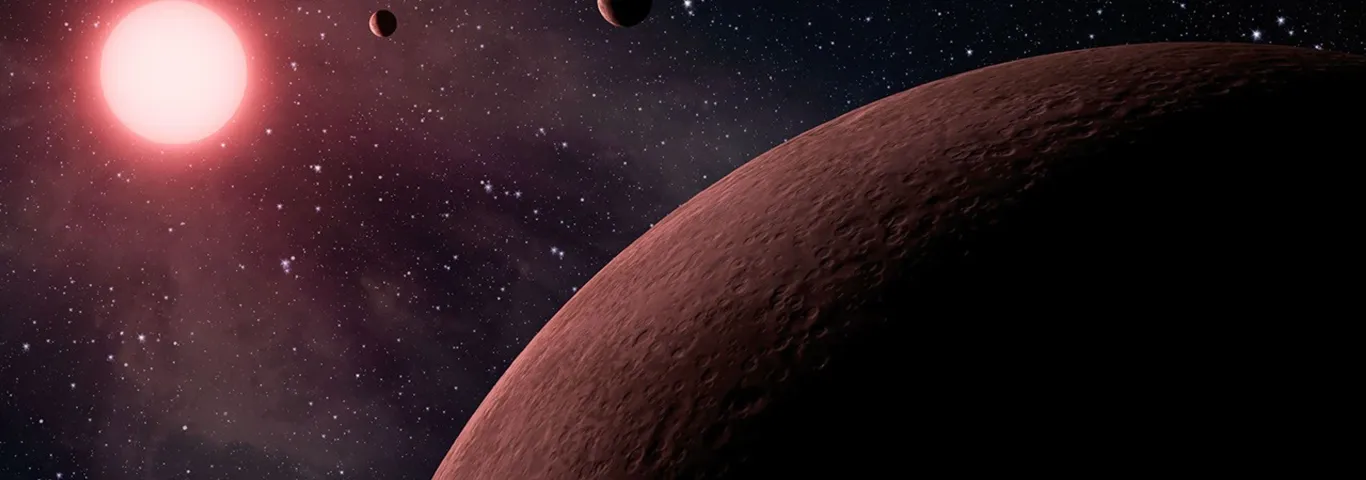
Header image: An artist's conception of three small planets orbiting a red star, discovered using data from NASA's Kepler mission. (Credit: NASA)

