
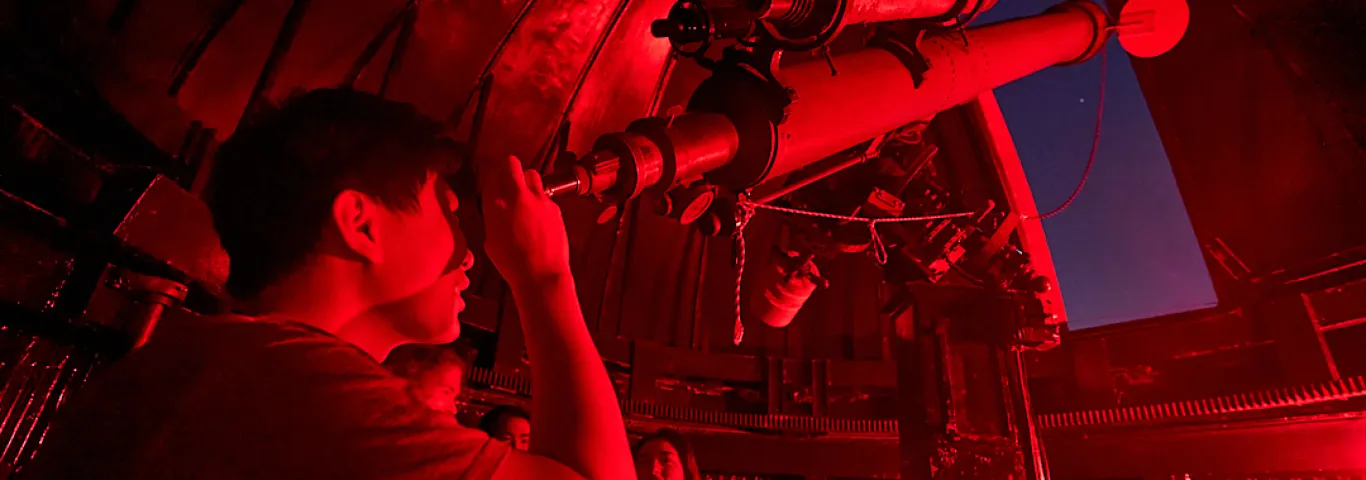

On Saturday, October 4, the McDonnell Center for the Space Sciences, in collaboration with the Departments of Physics and Earth, Environmental, & Planetary Sciences, all within Arts & Sciences, hosted a special evening at the Crow Observatory to celebrate International Observe the Moon Night.
This global event invited everyone interested in learning about and connecting with the Moon. As Jeffrey Gillis, research professor of physics and a fellow of the McDonnell Center for the Space Sciences, explained, “The Moon is a great entry point for being engaged with space science and exploration because it can be seen despite light pollution or the need for a telescope, and it’s the only object in our Solar System that humans have set foot on.”
Under clear skies, guests enjoyed spectacular views of the Moon through the historic Crow Observatory telescope, spotting craters and mountain ranges in striking detail. Visitors also enjoyed pizza and Moon Pies as they examined real lunar and Martian meteorites, courtesy of Jeff Gillis. Megan Broussard, a McDonnell Center Graduate Fellow from the Department of Earth, Environmental, & Planetary Sciences talked with visitors about how the special meteorites were delivered to Earth and how we know that they're from the Moon and Mars, and not from asteroids.

International Observe the Moon Night is an annual event sponsored by NASA's Lunar Reconnaissance Orbiter mission and the Solar System Exploration Division at NASA's Goddard Space Flight Center, with many contributors. It is designed to raise awareness and understanding of the Moon’s role in science and exploration. By participating, the WashU community joined thousands of observers across the world in celebrating the wonder of our closest celestial neighbor.
Whether it was someone seeing the Moon through a telescope for the very first time or a seasoned scientist sharing stories about past lunar missions or how Earth got its Moon, the night served as a reminder of one simple truth – sometimes, the best way to explore the Universe is just to step outside and look up!
The Crow Observatory is open on clear evenings during the fall and spring semesters, Monday through Friday from 7-10pm during standard time and 8-10pm during daylight savings time. Visits are free and open to the public. Email crowobservatory@wustl.edu to learn more and schedule a visit. Read more about the history of the Crow Observatory.


