
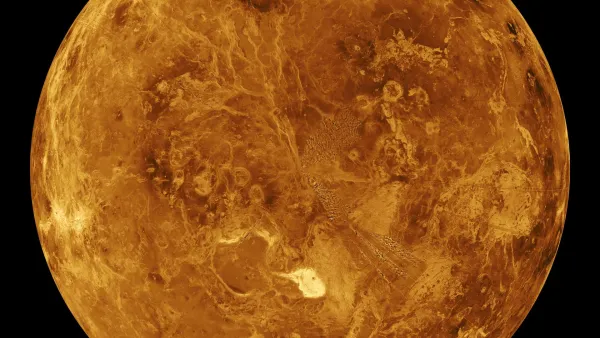
Venus is our bright and beautiful planetary neighbor and a source of fascination for humans over many centuries. In a recent episode of The UnXplained: Mysteries of the Universe, William Shatner narrates us through an exploration of the planet.
Associate Professor Paul Byrne from the Department of Earth, Environmental, and Planetary Sciences weighs in throughout the episode. He points out the similarities of Venus to Earth as well as the profound differences, shedding light on why some scientists refer to Venus as “Earth’s Evil Twin”.

There is another major difference. Because of the extremely slow rotation of Venus, one day is actually longer than one year on the planet. While Earth has our Moon orbiting and regulating our rotation, Venus has no moon. Venus also spins in the opposite direction of most other planets in our solar system and takes 243 Earth days to complete a full day. A year on Venus is only 225 Earth days.
The possibility that Venus was more habitable and Earth-like in the past isn’t just science fiction. There is a real possibility that 1-2 billion years in the past it may have been a kinder atmosphere and terrain. Experts are theorizing Venus’s cloud-layer contains life. Some even wonder, if we could get the science and technology just right, will humans be sent to Venus? Perhaps studying from blimps, living among the clouds?
To watch Professor Byrne and other planetary scientists tackle the science of Venus’ past and what the future of exploration on Venus could be watch The UnXplained: Mysteries of the Universe Season 1, Ep. 4 Venus: Earth's Evil Twin. Available now on the History Channel app and Prime Video.
Header Image Credit: Venus from the Spacecraft Magellan. NASA Images

