
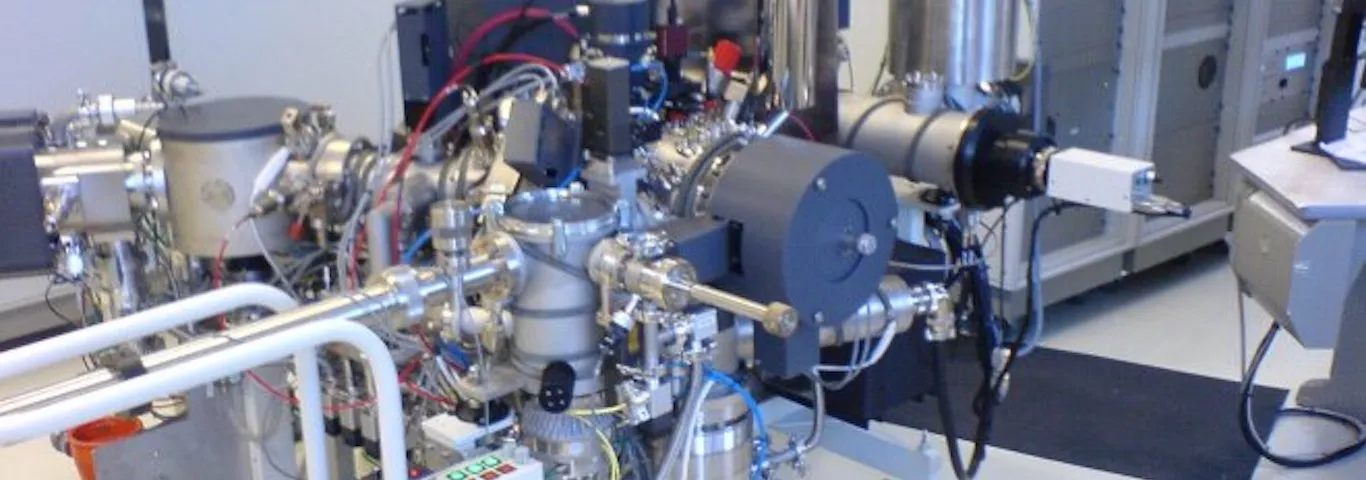
Secondary ion mass spectrometry (SIMS) is one of the most sensitive techniques for studying surfaces of materials. It can determine the surface chemical composition, very precisely, detecting elements at down to parts-per-billion levels. By focusing a beam of charged atoms (ions) onto the surface of the sample, atoms are ejected (a process called sputtering). Using lenses and a mass spectrometer, the initial location and type of atom (chemistry and isotope) can be identified to a very high precision. Sputtering can also be used to progressively erode the sample, allowing three-dimensional chemical/isotope profiles to be obtained. A significant advantage of SIMS is that it is sensitive to all elements in the periodic table.
The Cameca IMS 7f-Geo SIMS is especially configured to measure stable isotope ratios (both natural abundance and isotopically labeled samples) with very high precision from sputtered areas that are a few micrometers in diameter. The instrument can acquire data quickly thanks to a 3-collector detection system that is optimized for fast peak switching. It is highly automated with custom software that is adapted for rare earth element (REE) measurements. Because of the capabilities for high sensitivity, depth profiling, and imaging, the IMS 7f instrument series can be widely used by scientists across many disciplines, including materials science (e.g., semiconductors, photovoltaics, ceramics, and assorted metallic alloys), geochemistry cosmochemistry (mass-dependent and mass-independent isotopic fractionation; REE abundance patterns, H in nominally anhydrous minerals), and biology and medicine (inter- and intra-cellular metabolite uptake (e.g., 13C, 15N labels) and metal co-factor abudance). WashU's SIMS facility is located in the lower level of Rudolph Hall (Room L74), adjacent to the facilities of the Institute of Materials Science and Engineering (IMSE). Interested users, please contact Dr. David Fike (dfike@wustl.edu), PI overseeing the lab, or Dr. Kaitlyn McCain (mccain.k@wustl.edu), the research scientist overseeing the day-to-day operation of the laboratory.
